 GOV
GOV
City of St. Louis CDA Releases “A Ten-Year Strategy to Reduce Vacancy in the City of St. Louis” Report with New Data and Strategies to Address Vacant Properties
The report commissioned by CDA and prepared by the STL Vacancy Collaborative outlines roadmap for coordinated action.


The City of St. Louis’ Community Development Administration (CDA) today released a new report titled “From Policy to Progress: A Ten-Year Strategy to Reduce Vacancy in the City of St. Louis.” The 68-page report and strategy is a comprehensive analysis of the scale, cost, and potential solutions to vacant and abandoned properties, one of the most persistent challenges in St. Louis neighborhoods.
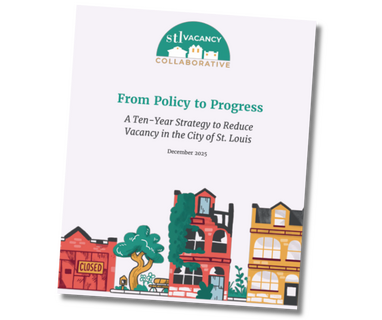
The report was commissioned by CDA and prepared by the STL Vacancy Collaborative (STLVC), a coalition of residents, nonprofits, businesses, researchers, and public agencies dedicated to reducing vacancy and its impacts across the city.
The analysis builds on two years of work through the Vacancy Strategy Initiative (VSI), which brought together more than a dozen City departments and hundreds of community participants to analyze vacancy issues, trends, and data and develop strategies for addressing the issue.
“Vacancy affects everyone - the stability of neighborhoods, property values and the long-term fiscal health of our city,” said Mayor Cara Spencer. “I would like to thank CDA and the STL Vacancy Collaborative for making sure we, as a city, have solid data that we will use as we ramp up our efforts to tackle vacancy and build stronger neighborhoods across St. Louis.”
“CDA is committed to stabilizing neighborhoods and growing affordable housing in the City of St. Louis,” said Matt Moak, Executive Director of the Community Development Administration. “We are grateful for the many housing development partners whose success stories are highlighted in this report. We look forward to continuing successes together.”
Today, St. Louis has more than 24,000 vacant parcels, including over 9,000 vacant buildings and approximately 15,000 vacant lots. The report finds that nearly 90 percent of vacant buildings in St. Louis are privately owned, underscoring the need for coordinated action between government, residents, and the private sector.
Vacancy also carries significant financial costs for residents and for the City of St. Louis taxpayers. The report estimates:
- $310 million in lost personal property value and unrealized family wealth from vacant property affecting the value of nearby occupied homes and properties.
- $25 million in lost potential annual real estate tax revenue due to the collective depressed property values
- Approximately $20 million annually in City services dedicated to maintaining vacant property, including $9,250,000 from public safety services (EMS, police, fire,).
Vacancy is also geographically concentrated. Approximately 84 percent of vacant parcels are located north of Delmar Boulevard, reflecting decades of population loss, disinvestment, and structural inequality.
The report also highlights success stories led by community development corporations and nonprofit developers, demonstrating how coordinated investment and neighborhood leadership can transform vacant properties into affordable housing, community assets, and new economic opportunity.
In addition to analyzing the causes and costs of vacancy, the report proposes a ten-year roadmap for coordinated action, including:
- Establishing stronger coordination across City departments and agencies
- Modernizing parcel-level data systems and public dashboards
- Expanding financial tools to stabilize and redevelop vacant properties
- Targeting strategies based on neighborhood vacancy conditions
- Increasing transparency and community engagement in vacancy reduction efforts.
The views and conclusions expressed in the report are those of the authors and the STL Vacancy Collaborative and do not necessarily represent the official positions of the City of St. Louis or the CDA.
About the Community Development Administration (CDA):
Established in 1974, CDA invests approximately $25 million each year in affordable housing, community development, and public services across St. Louis. As the City’s housing and community development agency, CDA works in partnership with HUD, the Planning and Urban Design Agency and the St. Louis Development Corporation to ensure that funding priorities are transparent, competitive, and community-driven.
-
Contact Information:
Tom Nagel
Public Information Officer II -
Department:
Community Development Administration
-
Topic:
Community
Construction, Maintenance, and Improvements
Beautification and Nuisance Reduction
Housing
Home Repairs and Renovation
Local Government Services
Urban Development and Planning
Related Stories
Help Us Improve This Page
Did you notice an error? Is there information that you expected to find on this page, but didn't? Let us know below, and we'll work on it.
Feedback is anonymous.


