 GOV
GOV
On the Map: Lynch's Slave Pens
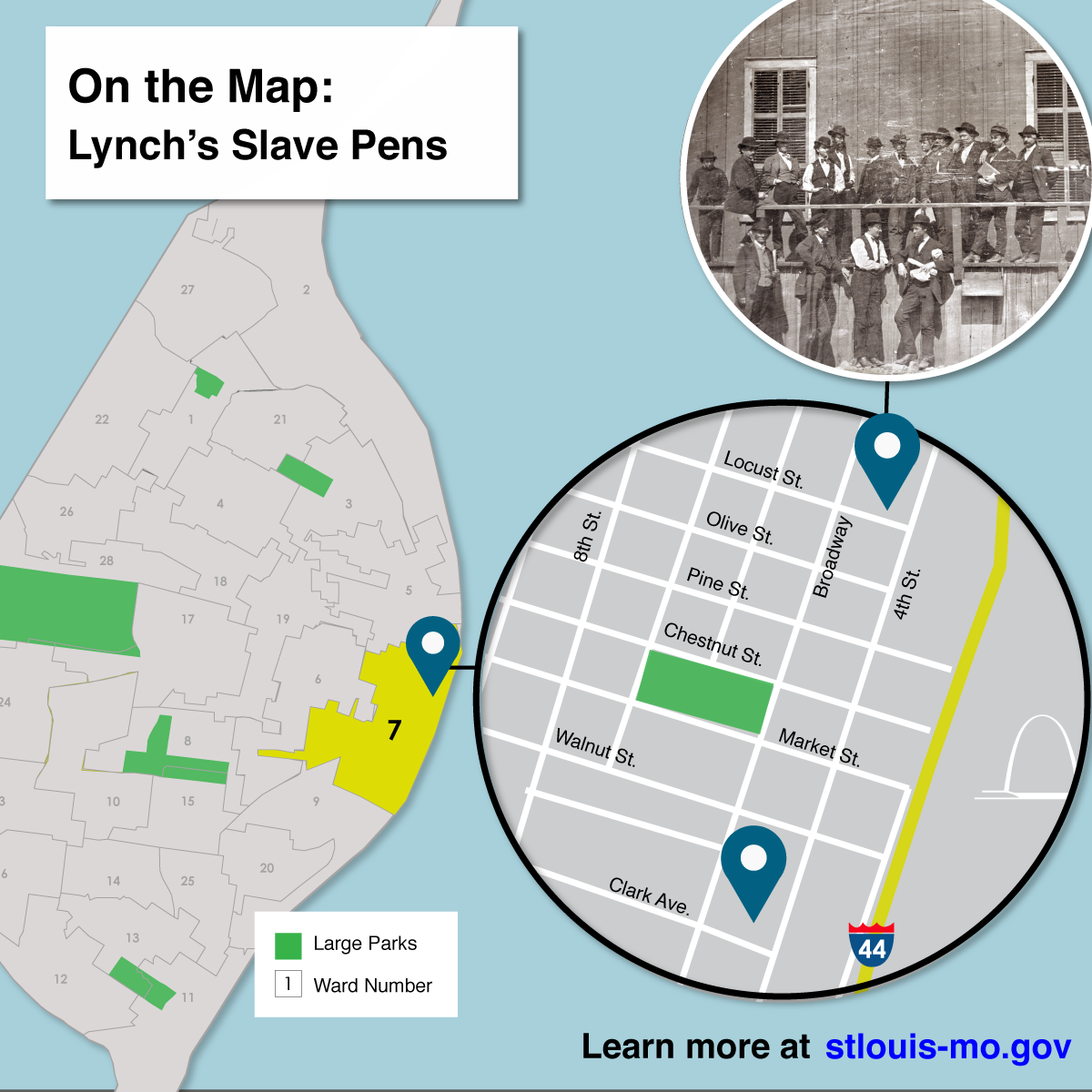
Lynch’s Slave Pens were holding places for enslaved men, women, and children before they were sold at slave markets in downtown St. Louis


This article is 7 years old. It was published on June 15, 2018.
Too often the history of our city goes untold. The streets we walk down or houses we pass have a storied past that is sometimes forgotten. To commemorate Black History throughout the year, we will be sharing the stories of places in our city that in one way or another have been home to the rich history of Black St. Louisans.
This edition of On the Map focuses on Lynch’s Slave Pens and their role in slave trafficking across Missouri in the mid-nineteenth century.
Lynch’s Slave Pens were holding places for enslaved men, women, and children before they were sold at slave markets in downtown St. Louis and often auctioned off on the steps of the Old Courthouse. They were named after Bernard Lynch, a slave trafficker known in St. Louis for the significant number of slaves he sold and for his widespread advertisements.
The pens themselves were cramped and constructed like prison cells. Each person was shackled, the rooms were bolted and locked, and bars were placed on the windows. Several of Lynch’s Pens existed across downtown, including one located at 104 Locust Street and at the intersection of Clark and Broadway near the current location of Busch Stadium.
An abolitionist and minister named Galusha Anderson visited the pens and detailed her experience in her book The Story of a Border City During the Civil War. Anderson recalled a mother’s fear that she would be separated from her child and the collective fear amongst the slaves that they would be sold down the Mississippi River to the South. She also highlighted the story of one of Lynch’s Pens that only contained children.
During the Civil War, the slave pens were closed and Union soldiers used them as prisons for Confederate sympathizers. The slave pens were destroyed in 1963.
References
- Curious Louis: Uncovering what remains of St. Louis’ slave trading past - St. Louis Public Radio
- Dishonorable monuments - St. Louis Magazine
- The Story of a Border City During the Civil War by Galusha Anderson
-
Contact Information:
-
Department:
Office of the Mayor
Planning & Urban Design Agency
-
Topic:
History and Heritage
Most Read News
- Delta Air Lines Starts Non-Stop Service To JFK From STL STL is now linked with America’s most connected airport for international flights
- City of St. Louis and Missouri Green Banc Awarded National Grant For Innovative Energy Investments Missouri Green Banc is awarded a national grant for building an innovative pipeline of investments to bring down energy prices for St. Louisans.
- First Three Months of 2025 See Lowest Crime Rates in City of St. Louis in More Than 20 Years As of March 31, 2025, homicides are down 45%, robberies are down 20%, burglaries are down 33%, and auto thefts are down 39%, year-to-date.
Help Us Improve This Page
Did you notice an error? Is there information that you expected to find on this page, but didn't? Let us know below, and we'll work on it.
Feedback is anonymous.


