 GOV
GOV
CDA 2020-2024 Impact Report: HUD Compliance Framework
CDA manages four HUD formula programs which are allocated to the City on an annual basis subject to congressional appropriation.


This article first appeared in the CDA 202-2024 Impact Report (April 2025), a comprehensive look at five years of housing, community development, and neighborhood revitalization efforts in St. Louis. To learn more about CDA’s programs, investments, and impact citywide, read the full report here.
HUD Formula Funds
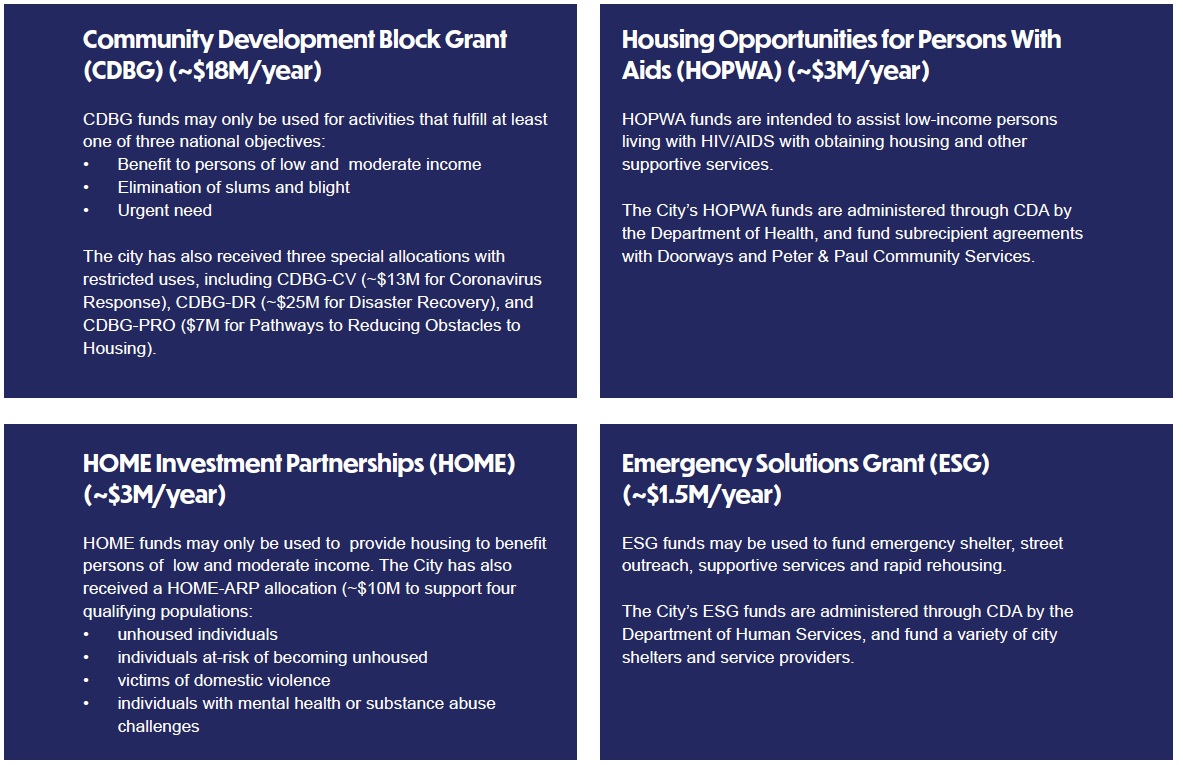
Community Development Block Grant (CDBG) (~$18M/year)
CDBG funds may only be used for activities that fulfill at least one of three national objectives:
• Benefit persons of low and moderate income
• Elimination of slums and blight
• Urgent need
The City has also received three special allocations with restricted uses, including CDBG-CV (~$13M for Coronavirus Response), CDBG-DR (~$25M for Disaster Recovery), and CDBG-PRO ($7M for Pathways to Reducing Obstacles to Housing).
Housing Opportunities for Persons With AIDS (HOPWA) (~$3M/year)
HOPWA funds are intended to assist low-income persons living with HIV/AIDS with obtaining housing and other supportive services.
The City’s HOPWA funds are administered through CDA by the Department of Health, and fund subrecipient agreements with Doorways and Peter & Paul Community Services.
HOME Investment Partnerships (HOME) (~$3M/year)
HOME funds may only be used to provide housing to benefit persons of low and moderate income. The City has also received HOME-ARP allocation (~$10M) to support four qualifying populations:
• unhoused individuals
• individuals at-risk of becoming unhoused
• victims of domestic violence
• individuals with mental health or substance abuse challenges
Emergency Solutions Grant (ESG) (~$1.5M/year)
ESG funds may be used to fund emergency shelter, street outreach, supportive services, and rapid rehousing.
The City’s ESG funds are administered through CDA by the Department of Human Services, and fund a variety of city shelters and service providers.
Funding Opportunities
CDA allocates federal funds through open and competitive funding opportunities. Broadly speaking, funding opportunities fall into four families:
- CDA’s Spring Neighborhood Transformation Grants Notice of Funding Availability, which is focused on affordable housing and open to developers, CDCs, and neighborhood groups.
- CDA’s Fall CDBG Request for Proposals, which is focused on non-profits providing services to city residents, and also includes funding for façade improvements.
- Professional Services Requests for Proposals, which are governed by Ordinance 64102 and enable CDA to contract with for profit companies for professional services.
- Bid Solicitations, which are for contractors to bid on construction projects (i.e. stabilization of vacant buildings, recreation center repairs, façade improvements, etc.).
HUD Action Planning Process
Each of these HUD programs go through the same HUD approval process. At its core, this involves the city working with residents to develop the five year Consolidated Plan and an annual Action Plan, implementing these plans following HUD approval, and then reporting out the outcomes of funded programs to HUD. This process involves the following steps:
- Following a public hearing to solicit input on a draft, the City submits its five year consolidated plan to HUD.
- Following a public hearing on funding priorities, the City issues an RFP inviting non-profits to submit proposals for funding.
- Following a public hearing on proposed funding allocations, the City appropriates CDBG, HOME, ESG & HOPWA funds, including CDBG funds set aside for non-profits pursuant to the RFP process, and city programs, in an annual ordinance.
- Upon passage of the ordinance, and following another public hearing, the City submits its annual action plan to HUD 45 days before the end of the year. Typically the plan details the City’s efforts to implement the previously submitted consolidated plan, but every five years, including 2024, these plans are submitted together.
- Upon HUD approval of the action plan, the City enters into a grant agreement simultaneously, the City begins contracting with grantees, and issues a NOFA inviting developers to apply for zero interest housing development loans.
- Ninety days after the end of the program year, the City submits its Consolidated Annual Performance and Evaluation Report (CAPER) to HUD.
Income requirements
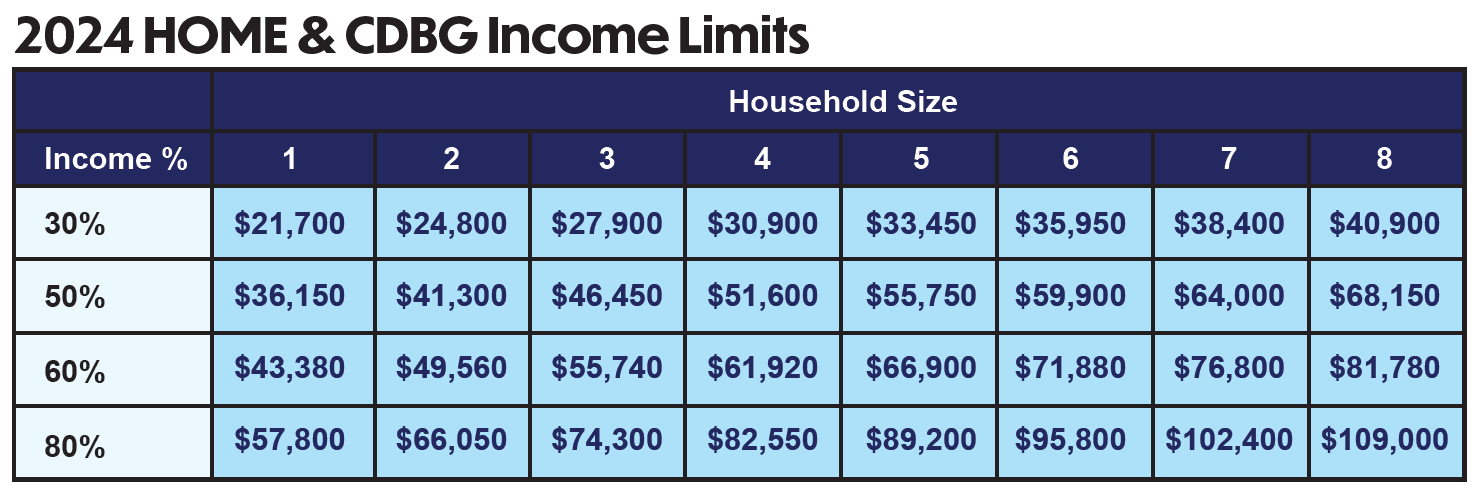
Most CDA programs are required to serve low to moderate income households. So who is low to moderate income? HUD defines it as households earning less than 80% of “Area Median Income” or AMI. Because AMI is calculated on a regional basis, the rates detailed in the table below make more than half of city residents eligible for CDA programs. The table below shows 2024 HUD income requirements. Current income limits are posted on CDA's webpage here.
About the Community Development Administration (CDA): The CDA serves as the City of St. Louis' hub for federal, state, and local funds, implementing the Mayor's economic justice agenda. By funding public and nonprofit entities, the CDA supports a wide range of initiatives, including public services, affordable housing development, blight eradication, and other community development activities.
-
Contact Information:
Tom Nagel
Public Information Officer II -
Department:
Community Development Administration
-
Topic:
Community
Federal and State Government Services
Housing
Policy Making
Planning
Related Stories
Help Us Improve This Page
Did you notice an error? Is there information that you expected to find on this page, but didn't? Let us know below, and we'll work on it.
Feedback is anonymous.


