 GOV
GOV
Overview
Significant transportation infrastructure improvements are planned and underway throughout the City of St. Louis as a consequence of unprecedented investment in how we travel for work, education, or recreation. More than $300 million is being invested in transportation infrastructure upgrades in St. Louis between 2025 and 2028. Additional information about St. Louis’ vision, values, and goals for transportation projects, policy, and design is contained in the Transportation & Mobility Plan.
The City is committed to making our streets, sidewalks, and surrounding infrastructure safe, convenient and enjoyable for everyone, whether they are driving a car, walking, riding a bike, taking public transit or using a mobility aid. Information about many current and upcoming transportation and public works managed by the City of St. Louis Board of Public Service is available here.
In other words, we are making our streets people-friendly.
On this page, you can learn more about the City’s priorities for building and updating transportation infrastructure, and you can stay informed about some of our major projects that will shape St. Louis for years to come. Further down, you can see the significant projects that are currently underway or funded and coming soon.
Priorities
Pedestrian-friendly
We’re narrowing travel lanes and installing bump-outs to slow down traffic, making it easier for pedestrians to get around. We’re also frequently shortening crosswalks and installing pedestrian refuge islands to make crossing our streets easier.
This work is already happening, as improvements on more than 30 miles of arterial roads continue, making it safer for pedestrians to walk alongside or cross the City’s major streets.
In December 2023, the City adopted its new Traffic Calming Guidelines to promote the use of traffic calming techniques, such as road diets, mini roundabouts, and other design strategies that reduce vehicle speed to improve pedestrian safety.
Disability-friendly
St. Louisans and visitors with disabilities should have the same opportunities to get around as everyone else. That’s why we keep improving accessibility as we maintain and upgrade our transportation infrastructure, and why the City adopted its ADA Transition Plan in January 2024. Since then, annual funding has made accessibility improvements to sidewalks, parks, public buildings and facilities, and other amenities.
If you see ADA-accessible infrastructure that has been damaged or blocked, please contact the St. Louis Citizens’ Service Bureau at 314-622-4800 or on the CSB website.
Bike-friendly
It should be safe, convenient, and enjoyable to ride a bike from one St. Louis neighborhood to another. To ensure this becomes a reality, the City is investing in more protected bike lanes and greenways to connect St. Louis. Soon, St. Louisans will be able to ride from the Gateway Arch to Forest Park, and from Fairground Park to Tower Grove Park without leaving a greenway, including the Tower Grove Connector, 20th Street Greenway, and the Brickline Greenway. The City and its partners are already envisioning the next steps as we work to connect the entire City.
Driver-friendly
The City of St. Louis has never before invested as much in improving its streets as it is now. Goodfellow, Union, Kingshighway, Grand, Jefferson, Washington, and Broadway corridors are among the arterials the City is resurfacing in 2024, 2025 and 2026 to make the ride as smooth as possible, while also adding features to make driving safer.
We are improving safety for everyone on City streets by reconfiguring lanes to reduce speeding, upgrading hotspot intersections to reduce the number of crashes, and routinely integrating safer roadway design into more projects.
Neighborhood-friendly
Calming traffic in our neighborhoods is a high priority for the City, which adopted the Traffic Calming Engineering Guidelines in December 2023. The City believes that traffic calming measures have immense potential to enhance safety, elevate livability and promote a sense of community by improving aesthetics.
A recent example of this priority is the Louisiana Calm Streets project, which was completed in 2023 to achieve those goals. The City installed bump-outs at corners, traffic circles at intersections, ADA-accessible sidewalks, and custom pavement markings for safety and neighborhood identity. Other recent neighborhood scale traffic calming projects include the Ivory Triangle safety enhancements, and improved pedestrian access to Carondelet and Francis Parks.
Significant Transportation Infrastructure Projects in St. Louis
The interactive map below shows significant transportation infrastructure improvements that have been funded and will be built between 2025 and 2028, plus the planned Green Line Bus Rapid Transit Project, which is currently in project development. Click on each project to learn more, or read about select projects below the map.
Map Details
More information about this map
A map of currently funded major transportation projects (bridge, safety, greenway, corridor repaving, street re-construction) within the City of St. Louis sponsored by the City of St. Louis, MODOT, Great Rivers Greenway, and Metro Transit. This map includes significant funded projects on the City of St. Louis street network (non highway) and the planned MetroLink Green Line light rail project (currently in project development). This map does not include planned but unfunded street and roadway projects, non-corridor based re-paving, sidewalk, or ward capital funded improvements.
Principal Arterial Traffic Safety Enhancements
The City is investing more than $46 million between 2024 and 2026 to improve pavement conditions and safety on about 30 miles of arterial City streets. Improvements will include lane reconfigurations and reductions, ADA improvements, additional shared and protected bike paths, shorter crosswalks, and pavement resurfacing.
Continental Crosswalks
High-visibility crosswalks are more visible to approaching drivers, and improve driver yielding behavior. These crosswalks increase pedestrian awareness.
Expected Crash Reduction: 40% for pedestrian involved crashes
Road Diet
Road diets or lane diets reallocate excess travel lanes to other uses to slow traffic speeds, reduce aggressive driving, and provide street space for bicycles, extended sidewalks, or parking.
Expected Crash Reduction: 30% to 47% for non-intersection crashes
Medians
Raised concrete islands divide travel lanes in opposing directions, provide safety buffers, and protection for pedestrians crossing the street.
Expected Crash Reduction: 68% for head-on crashes
Bump Outs
Raised concrete extensions at street corners serve to tighten intersections, slow turning vehicles, reduce pedestrian crossing distances, protect parking lanes, and enhance pedestrian visibility.
Expected Speed Reduction: 2-4 mph
Construction began in the fall of 2024 on the first of those streets, Kingshighway Boulevard, which will be repaved and improved from Florissant Avenue to Gravois Avenue. Between the fall of 2024 and the fall of 2026, the City will also repave and improve Grand, Goodfellow, Union, Jefferson, 4th Street, Convention Plaza, and Broadway.
As part of this project, the City will calm traffic and improve safety at 10 hotspot intersections with high crash volumes.
Learn more about the Principal Arterial Traffic Safety Enhancements here.
Tower Grove Connector
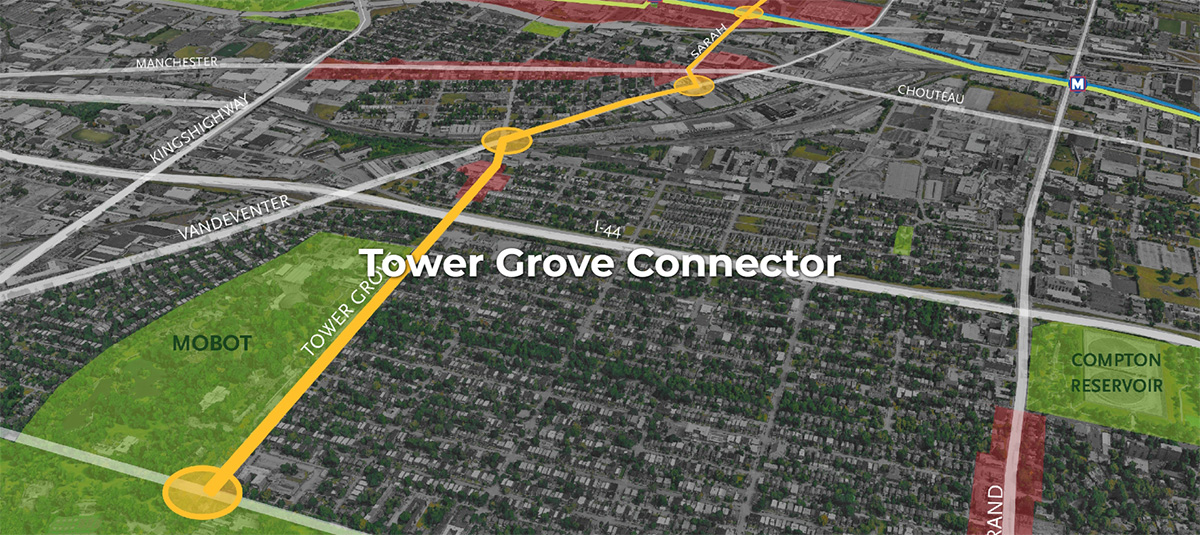
The City is building a brand-new, high-quality bikeway from Tower Grove Park to Cortex. This bike path, which will connect to the Brickline Greenway, is a the sidewalk level and protected from traffic by a curb and landscaping.
The project, which includes dedicated signals for bike traffic, will also add pedestrian crossing signals, ADA improvements, raised mid-block crosswalks on Tower Grove Avenue, as well as a simplification of the five-way intersection at Tower Grove Avenue, Vandeventer Avenue, and Central Industrial Drive.
Construction on phase one began in 2025, and construction on phase two is expected to begin in late 2026 and will likely take less than a year. The combined project will cost about $15 million.
Jefferson/Parnell Avenue Reconstruction
In addition to the Principal Arterial Traffic Safety Enhancements outlined above, the City has invested $25 million in the complete reconstruction of Jefferson and Parnell avenues from Chouteau Avenue to Natural Bridge Avenue. The work, which was completed in 2024, includes new curbs and sidewalks, safer crosswalks, repaved streets, and a raised median.
Brickline Greenway
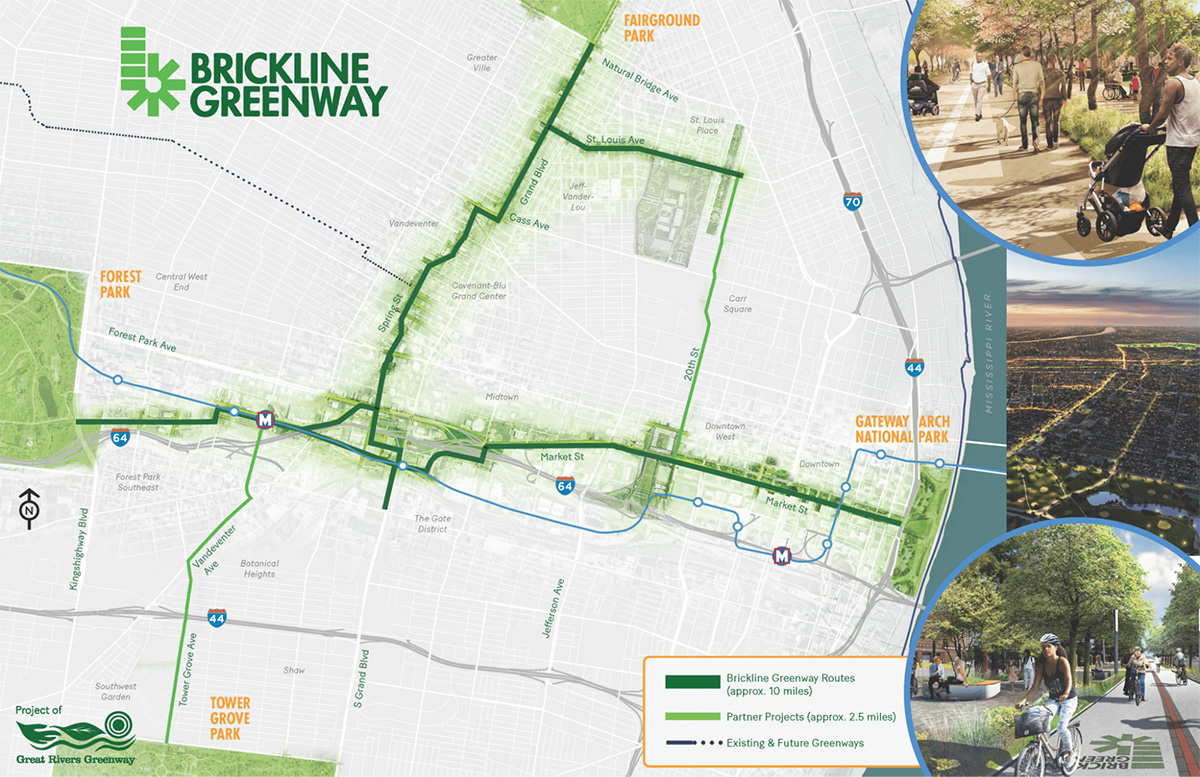 A 10-mile greenway connecting 14 St. Louis neighborhoods, the Brickline Greenway, along with other projects like the Tower Grove Connector, will enable St. Louisans to safely travel by bike, walk, or use a mobility aid from the Arch to Fairground Park, Forest Park and Tower Grove Park, all on high-quality greenway trails.
Sections of the Brickline Greenway have already been completed, while other sections will be built in the years ahead. Once completed, this Great Rivers Greenway project - built in partnership with the City of St. Louis - will be the crown jewel of trail infrastructure in the region.
South Broadway Cycle Track
A new 2.1-mile protected bike lane on South Broadway from River City Casino Boulevard to Dover Street will create a key connection between the existing River Des Peres and South Mississippi River Greenways, Sister Marie Charles and Bellerive Parks, and other amenities along the South Broadway Commercial District.
The $2 million project will begin in 2026 and will include a two-way bike lane on the east side of the street, roadway and traffic calming safety enhancements, pavement improvements, and ADA sidewalk upgrades.
Learn more about the South Broadway Cycle Track here.
20th Street Cycle Track
A nearly 2-mile greenway at sidewalk level along 20th Street, between Market Street and St. Louis Avenue, will provide a safe and convenient connection from north St. Louis neighborhoods to the Brickline Greenway on Market St. The project will also include traffic calming and full accessibility and sidewalk reconstruction through the entire corridor, making this route safer for everyone using it. Construction on the $13.5 million project is underway and will be complete in 2026.
Tucker Boulevard Cycle Track
This street-level cycle-track, which began construction in 2025, will connect Chouteau Ave. to Washington Ave, making it safer for bicyclists to cross the railroad tracks and highway just south of Downtown. The $2 million project includes a new street-level, parking-protected cycle-track on Tucker, and sidewalks and ADA improvements to both sides of the street.
Learn more about the Tucker Boulevard Cycle Track here.
Deer Creek Greenway
Great Rivers Greenway, in partnership with the City of St. Louis and other local governments and organizations, is extending the Deer Creek Greenway from its current endpoint at Big Bend Boulevard to connect to the River des Peres Greenway at the intersection of Ellendale and Canterbury in St. Louis.
Construction on this project will begin in 2026, creating a connection between Brentwood, Webster Groves, Maplewood and St. Louis, including the Shrewsbury Lansdowne Metrolink station, and creating nearly 30 miles of continuous trails greenways Carondelet, Jefferson Barracks, and Brentwood Parks and the Mississippi River.
Transportation & Mobility Plan
In tandem with these ongoing and planned projects, the City began developing its first comprehensive and citywide Transportation & Mobility Plan in decades. The City’s Planning Commission, and the Board of Public Service, adopted the plan in late 2025. The planning process was a collaborative effort among many City departments and included extensive engagement with residents of St. Louis.
The completed Transportation and Mobility Plan (TMP) is now a guiding document for a comprehensive strategy to shape transportation investments and policies, ensuring that all residents, businesses, and visitors can benefit from investments in St. Louis’ mobility systems.
The completion of the TMP gives the City of St. Louis a chance to embrace a new approach to how it thinks about transportation, by focusing on better designs for vulnerable road users, incorporating updated nationally recognized best practices, and utilizing new technologies. The TMP ensures the city remains competitive and responsive to evolving mobility needs, while meeting the needs of today’s residents.
The completion of the TMP gives the City of St. Louis a chance to embrace a new approach to how it thinks about transportation, by focusing on better designs for vulnerable road users, incorporating updated nationally recognized best practices, and utilizing new technologies. The TMP ensures the city remains competitive and responsive to evolving mobility needs, while meeting the needs of today’s residents.
The three key themes of the plan are a focus on safety, connectivity, and maintenance and quality of our transportation infrastructure. Actionable goals are associated with each of these themes.
Report a Problem
You can request city services, such as repairing a pothole, improving accessibility, or installing a traffic sign, through the Citizens' Service Bureau. Call CSB at 314-622-4800 or submit a report online.
Help Us Improve This Page
Did you notice an error? Is there information that you expected to find on this page, but didn't? Let us know below, and we'll work on it.
Feedback is anonymous.


