 GOV
GOV
About City Earnings Tax
A breakdown of City of St. Louis general fund revenue sources, including City earnings tax.
Overview
Like most cities, the City of St. Louis is funded by taxes, fees, and licenses. One of those taxes is called the City Earnings Tax (Prop E) and is a 1% income tax paid by individuals who work in the City of St. Louis. Retired and unemployed individuals do not pay the tax.
The City uses funds from the earnings tax to improve city services through the Police Department, Streets Department, Fire Department, and other departments and divisions.
The City votes on the Earnings Tax every five years. The tax was last approved in 2021 by 79% of St. Louis voters. On April 7th, 2026, residents will vote on whether the City should continue the Earnings Tax.
General Revenue Makeup
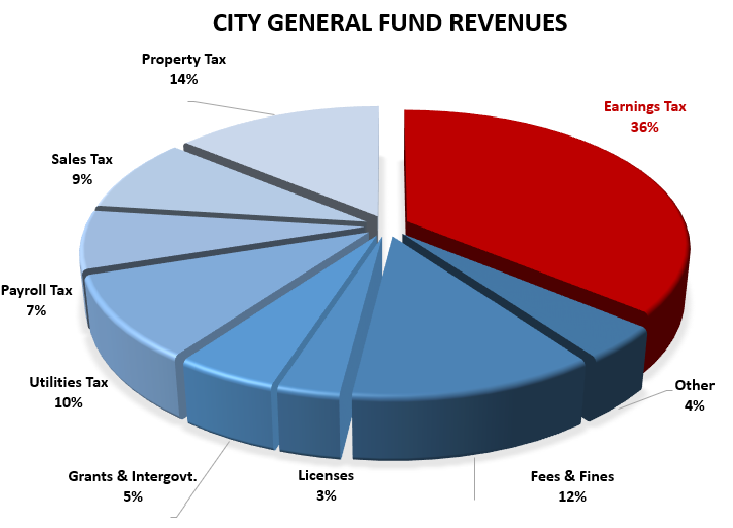
Earnings tax makes up 36% of the general revenue for our city.
| Revenue Source | Percent of General Fund |
|---|---|
| Earnings Tax | 36% |
| Property Tax | 14% |
| Fees & Fines | 12% |
| Utilities Tax | 10% |
| Sales Tax | 9% |
| Payroll Tax | 7% |
| Grants & Intergovernment | 5% |
| Other | 4% |
| Licenses | 3% |
How Earnings Tax is Used
City revenue is used to improve and maintain City Services. These revenue numbers pertain to the City’s general fund budget, which is the main source of funding for City services.
- Fire Department and Fire Pension - $84.8M
- Police Department - $178.5M
- Corrections and Juvenile Detention - $55.5M
- Forestry Division Trimming/Weed and Debris - $11.4M
- Park Maintenance - $12M
- Street Maintenance, Repair and Lighting - $10.7M
- Neighborhood Stabilization Services - $3.2M
- Equipment Service Vehicle Maintenance/Repair - $15.9M
City Earnings Tax Facts
- The current rate of 1% was imposed in 1959.
- Earnings Tax paid by individuals is 78% of the total amount received last year. The remaining 22% was paid by businesses.
- Other major cities that have earnings and/or income taxes include:
- Baltimore
- Cincinnati
- Cleveland
- Columbus
- Louisville
- Kansas City
- New York
- Pittsburgh
- Philadelphia
- The growth rate for the tax over 3 years, 5 years, and 10 years, is more consistent than property and sales taxes.
Help Us Improve This Page
Did you notice an error? Is there information that you expected to find on this page, but didn't? Let us know below, and we'll work on it.
Feedback is anonymous.


