 GOV
GOV
CDA 2020-2024 Impact Report: Housing Justice Strategy
Housing is a human right and all St. Louisans deserve safe, stable and affordable housing. Housing is the foundation for community well being.


This article first appeared in the CDA 202-2024 Impact Report (April 2025), a comprehensive look at five years of housing, community development, and neighborhood revitalization efforts in St. Louis. To learn more about CDA’s programs, investments, and impact citywide, read the full report here.
In 2024, CDA, in partnership with the Planning Department and SLDC, applied for and won a $7M HUD PRO Housing grant. PRO Housing stands for “Pathways to Reducing Obstacles to Housing” and encouraged the City’s development agencies to work together to refine housing vision and strategy.
Using reports including “Segregation in St. Louis: Dismantling the Divide” (2018); “Regional Affordable Housing Report Card” (2021); and CDA’s own “City's of St. Louis' 2023 Affordable Housing Report” (2023) as a starting point we aligned around a vision:
Housing is a human right and all St. Louisans deserve safe, stable and affordable housing. Housing is the foundation for individual and community well being, and the City of St. Louis is committed to supporting the community driven production and preservation of housing as diverse as our city.
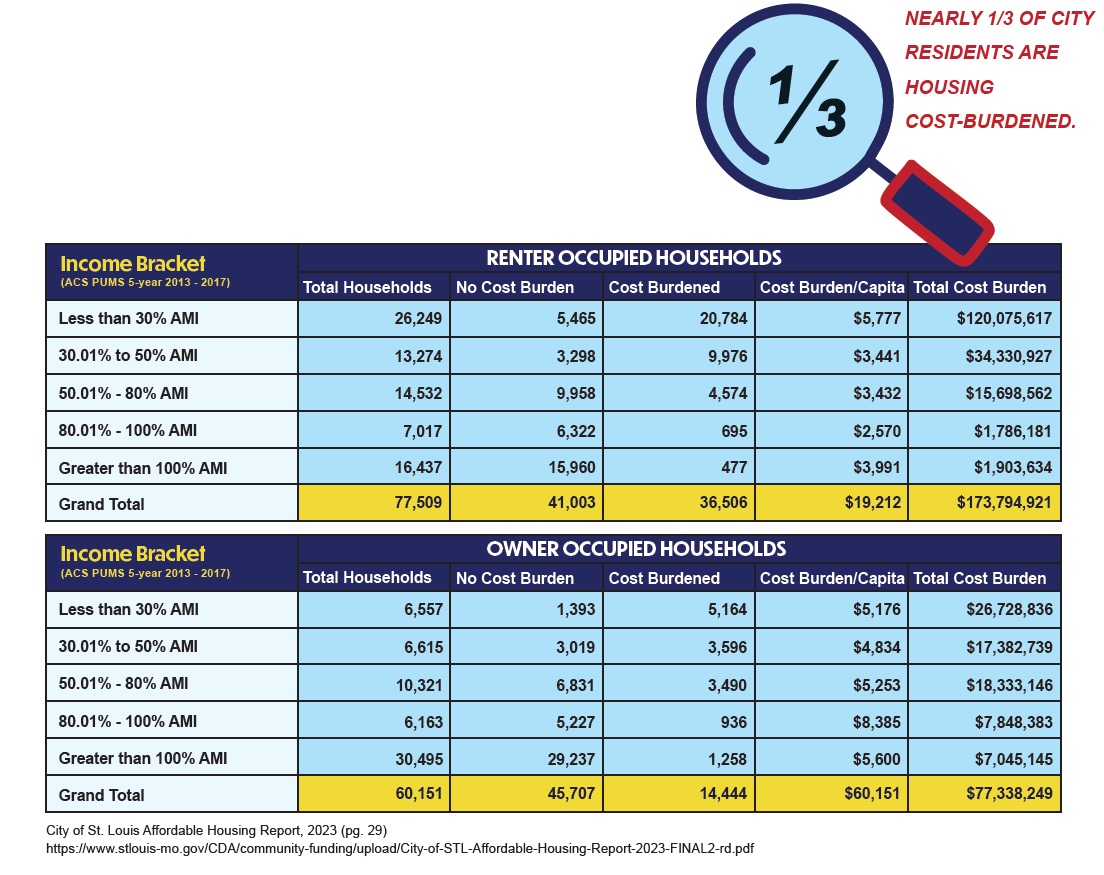
The City's of St. Louis' 2023 Affordable Housing Report also made the scale of the challenge clear. It showed that, despite our region’s reputation for affordability, more than fifty thousand households in the City of St. Louis are cost burdened. The bulk of the burden is borne by households earning less than 50% Area Median Income, who collectively pay more than $200M more in rent than they can afford every year. At its most acute, this crisis of affordability becomes an eviction and homelessness crisis.
Housing Justice Strategy
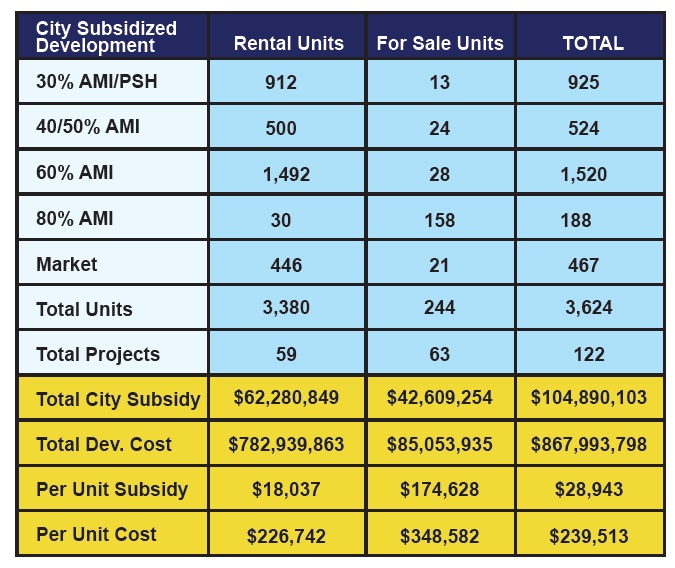
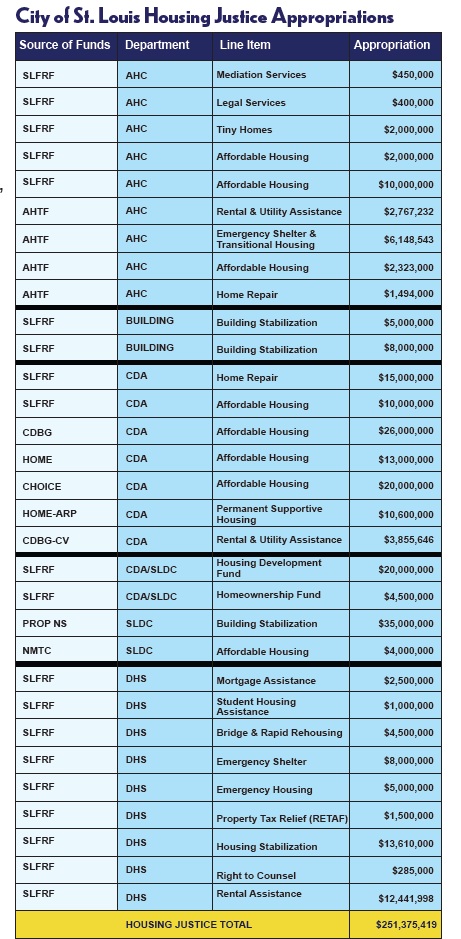
In order to address this extraordinary need, Mayor Jones set an ambitious goal of developing 1,000 units of affordable housing in the City of St. Louis by 2030. The City’s development agencies responded by committing over $250M towards housing justice initiatives, leveraging public-sector market development, and leveraging federal, state, local, private and philanthropic funds, as well as city-owned properties, to dramatically expand and diversify the pipeline of city subsidized projects. Whereas the City subsidized 1,261 affordable units between 2015 and 2019, including just 39 under 30% AMI units, and 65 for sale homes, we are currently subsidizing the development of a total of 3,624 affordable units, including 925 units under 30% AMI, and 244 for sale homes.
These efforts have dramatically diversified and expanded the City’s housing programs, and have been guided by the following principles:
- Focused: Recent funding cycles prioritized awards pursuant to the City’s Economic Justice Index (EJI), which is based on variables including life expectancy, lower crime rates; income, educational outcomes, property values, rent increases and more.
- Asset-Based: A new community assets mapping tracking the City’s schools, grocery stores, parks, major transit routes, health clinics, recreation centers, libraries and more has allowed us to incentivize asset-based development with bonus points to projects within 1,000 feet.
- Inclusive: Recent funding cycles have incentivized applicants to follow AHC’s Universal Design Standards, and required rental projects to follow fair housing practices including good cause eviction, mediation prior to eviction, tenant relocation fees.
- Resilient: Recent funding cycles have incentivized higher quality, more sustainable construction with bonus points for projects which adhere to Energy Star and Building Energy Performance Standards, and which upgrade from vinyl to more durable materials.
- Community Driven: In order to empower residents to identify priority sites for development, recent funding cycles include bonus points for projects which implement a neighborhood plan, and the City has expanded its investment into neighborhood planning.
More fundamentally however, our PRO Housing application encouraged us to shift from reactive to proactive development processes. Zoning reform led by the Planning and Urban Design Department (PDA) is an essential component of this work, but at CDA, we also come to recognize that in order to accelerate housing development and catalyze equitable and sustainable growth, we must shift from a traditionally reactive funding process, to a more proactive approach.
Historically, the City has awarded housing funds pursuant to an annual Notice of Funding Availability (NOFA). This approach places the responsibility to initiate development squarely on the shoulders of developer applicants. While this has resulted in the emergence of excellent projects, it also leaves the city in a passive role, reacting to market forces which are unwilling to develop in neighborhoods which need the most support. In recent years, the Community Development Administration has recalibrated its NOFA with the addition of bonus points designed to prioritize the rehabilitation of vacant buildings near transit, parks, schools, and other amenities, with a particular focus on economic justice demonstration areas. While this has proven to be a step in the right direction, and we will continue to rely on the open NOFA process to award a subset of housing funds, we believe that we can be most impactful by building our capacity to conduct site-specific funding rounds, with a particular focus on city-owned properties.
We are piloting this new approach now in the Ville, where we are committing $3.25M of PRO Housing funds to a specified set of contiguous parcels across two and a half blocks. We worked with the neighborhood planning committee to identify sites and look forward to bringing developer proposals before them for input prior to selection. While managing such a process requires additional capacity, we believe that it will help bring costs down by forcing developers to compete for the same project, empower residents and community stakeholders to set development priorities, and accelerate project development by ensuring regulatory barriers are removed early in the process. Most importantly, it will allow the City to focus funding in critical markets for maximum impact.
Each of the activities proposed under the PRO Housing grant—from overhauling our zoning and land use regulations, to expanding our capacity for planning and engagement, to funding a site-specific funding cycle along and around the MLK corridor—moves us towards a future in which the City of St. Louis is proactively accelerating development in accordance with community priorities.
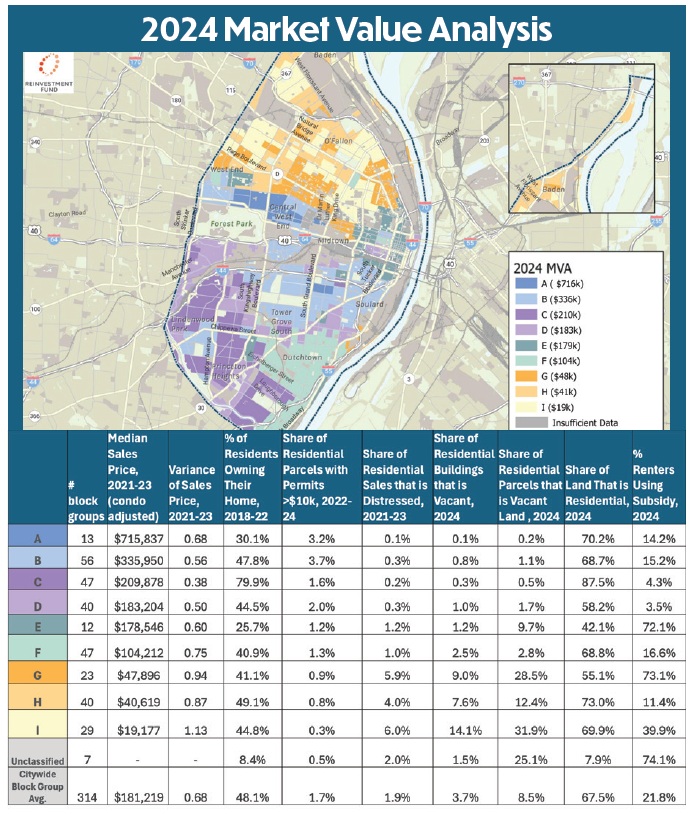
Another key tool which we have recently released, is an updated Market Value Analysis, conducted by our partners at the Investment fund as part of CDA’s five-year Consolidated Planning process. We have included highlights from this analysis below, and expect that developers and community stakeholders will find it useful.
Moving forward, CDA is committed to leveraging public resources, including capital, land, capacity and knowledge, to continue revitalizing distressed residential markets. We believe that holistic, block by block investments into the stabilization and rehabilitation of vacant buildings, coordinated with investments in home repair loans, downpayment assistance (second amortizing mortgages designed to fill appraisal gaps), paired with simultaneous investments into neighborhood beautification, transit and community assets poses the greatest potential for jump starting stalled housing markets.
About the Community Development Administration (CDA): The CDA serves as the City of St. Louis' hub for federal, state, and local funds, implementing the Mayor's economic justice agenda. By funding public and nonprofit entities, the CDA supports a wide range of initiatives, including public services, affordable housing development, blight eradication, and other community development activities.
-
Contact Information:
Tom Nagel
Public Information Officer II -
Department:
Community Development Administration
-
Topic:
Construction, Maintenance, and Improvements
Homelessness
Homeschooling
Housing Financial Programs
Home Repairs and Renovation
Home Ownership
Related Stories
Help Us Improve This Page
Did you notice an error? Is there information that you expected to find on this page, but didn't? Let us know below, and we'll work on it.
Feedback is anonymous.


