 GOV
Climate and Air
The City of St. Louis integrates several decarbonization efforts designed to address climate change, improve air quality and reduce greenhouse gas emissions caused by building energy consumption and fossil-fueled vehicles.
Global Covenant of Mayors for Climate & Energy
The City of St. Louis is fully compliant with the comprehensive climate planning and monitoring aspects of the Compact of Mayors. In November 2015, former Mayor Slay signed the Compact of Mayors (now the Global Covenant of Mayors for Climate & Energy), and pledged to gather greenhouse gas (GHG) data, set greenhouse gas emissions reduction targets, identify climate hazards, assess climate risks and vulnerabilities, and develop a climate action plan to address mitigation, as well as a climate adaptation plan. The pledge included a multi-year commitment that was tracked in phases through the award of earned badges. In November 2018, the City first earned all of the Compact of Mayors badges, and is considered 2021 Compliant with the Global Covenant of Mayors for Climate & Energy program. As part of the Climate Mayors, former Mayor Krewson summarized the City's sustainable Climate Protection Initiative goals and achievements in May 2020. Read it here.
Tracking Greenhouse Gases in the City of St. Louis
By regularly tracking greenhouse gas (GHG) emissions, the City of St. Louis can assess the effectiveness of its actions and policies towards reducing emissions and make plans for future improvements. GHG emissions are the release of gases into the atmosphere that trap heat and contribute to the greenhouse effect. These gases, like carbon dioxide and methane, occur naturally but are also produced by human activities mainly related to burning fossil fuels.
GHG emissions increase the frequency and severity of extreme climate activity. In St. Louis, this translates to higher risk of storms and flooding, as well as longer, hotter heat waves. These effects have been seen in four of the six hottest years on record occurring in the last decade, and in the severe flooding the city experienced in 2022. The city is also at risk of cold waves, drought and tornadoes, like the one experienced in May 2025. These events can cause major property damage, poor health outcomes, and even loss of life. The May 16, 2025, tornado that moved through the city claimed five lives, injured dozens, and is estimated to have caused $1.6 billion in damage, with more than 5,000 impacted buildings. Additionally, fossil fuels that contribute to greenhouse gas emissions also emit air pollutants that can cause asthma and other respiratory conditions.
Since 2005, the City has been committed to measuring and reducing the City's GHG emissions. Over time, this commitment has evolved to a citywide target of carbon neutrality by 2050 in alignment with the Global Covenant of Mayors for Climate and Energy and the Paris Agreement. This will require eliminating most emissions and addressing any that remain through sequestration methods such as tree canopies and/or through carbon offsets. The City has conducted GHG Inventories for the years 2005 (baseline), 2010, 2013, 2015, 2018 and 2023 (most recent report). Inventory reports have been shared with the Carbon Disclosure Project since 2012.
You can explore the data and compare the inventories' results in depth on the City's GHG Data Dashboard.
More Climate Planning
In 2016-17, the City's Sustainability Director worked with a team of consultants, community representatives with technical expertise, and departmental staff involved in climate issues, to develop a detailed Climate Action & Adaptation Plan recommended for the City of St. Louis Sustainability Plan.
To understand projections of the St. Louis Climate Hazards Report conducted by John Posey of East-West Gateway Council of Governments in 2016, the Office of Sustainability oversaw development of a City of St. Louis Climate Vulnerability Assessment, developed in conjunction with the City's Office of Resilience, City Departments of Health and Emergency Response, Planning & Urban Design Agency, and the Brown School at Washington University in St. Louis.
Renewable & Solar Energy
There are several renewable energy efforts underway in the City of St. Louis. Examples include:
- Solar-Ready Ordinance - signed by former Mayor Krewson in December 2019
- Equity-building Solar Workforce Development Pilot The City of St. Louis has been partnering with Employment Connection, IBEW and others to hold Solar Workforce Development programs. This summary document provides an overview of the December 2020 pilot and its outcomes. The Solar Workforce Development Pilot was featured by the U.S. Conference of Mayors "Building Partnerships for a Low-Carbon Future" in April 2021. Read the article here (on page 17 of the document). Employment Connection is accepting applications for future cohorts of the Solar Panel Workforce Development: Online applications here.
- Solar Rebates and Community Solar offered by Ameren Missouri
- Residential (Grow Solar STL) and Commercial (RenewSTL Solar) discounted solar panel purchase programs.
For information and resources related specifically to solar energy in the City, please visit the tab at left: Solar And The City.
Building Performance & Energy Efficiency
Existing buildings are the source of nearly 80% of the greenhouse gas (GHG) emissions in the City of St. Louis, so it is critically important to find ways to increase building performance, improve building energy efficiency, and expand clean sources of building energy.
In 2016-17, St. Louis became a City Energy Project awardee, with support from the Natural Resources Defense Council (NRDC) and the Institute for Market Transformation (IMT). In February 2017, former Mayor Slay signed an Energy Benchmarking Ordinance that applies to buildings greater than 50,000 square feet. Further information and supporting documents relating to Energy Benchmarking and Building Energy Performance are posted at www.stlbenchmarking.com. The City's energy benchmarking specialist and program is housed by the Building Division, which offers support, such as this benchmarking resource sheet. The Gateway Chapter of the USGBC partners with the City to hold Energy Benchmarking Training.
The City's Building Division compiles the energy benchmarking data and produces an annual Energy Benchmarking Report. The most recent St. Louis Energy Benchmarking Report is for calendar year 2018. Through the 2017 process, three municipal buildings were awarded ENERGY STAR status.
In 2017-18, the City's Building Division led the effort to update several existing Building Code elements to require greater energy efficiency. The updated Building Code provisions went in to effect in August 2018 and are among the most progressive in the Midwest.
In April 2020, Mayor Krewson signed an innovative Building Energy Performance Standard (also known as BEPS ordinance) into law. The Building Division has created a Building Energy Improvement Board (BEIB) and is establishing a new Office of Building Performance and board to assist with implementation of the BEPS ordinance.
Low Carbon Transportation
Vehicle Electrification
Electric Vehicles in the Municipal Fleet
Utilizing award funding from the Volkswagen Trust Settlement from the Missouri Department of Natural Resources the City has begun transitioning its municipal fleet to electric vehicles (EVs) and their associated EV charging infrastructure. In March 2021, the City of St. Louis unveiled the first municipal Chevy Bolts, 100% Zero Emission vehicles.

To institutionalize the practice of purchasing clean vehicles for municipal fleet, former Mayor Krewson signed Executive Order #68: Priority Procurement of Clean Municipal Vehicles in March 2021. A companion document describes the rationale for incorporating Lifecycle accounting principles, outlines the methodology for calculating the costs, and provides detailed implementation guidance for City Departments: Rationale and Implementation Strategy for Clean Vehicle Purchase.
Electric Vehicle "EV" Charging Readiness & Stations
EV Charging Stations For Public Use
- Six (6) EV Charging Station ports have been installed at St. Louis City Hall in the parking lot at Clark & Tucker. There is no cost to use the EV Charging Stations, but parking fees remain in effect. Here are answers to Frequently Asked Questions about the City Hall EV Charging Stations.
- The Airport has 5 free EV charging stations in Super Park Lot A (vehicle charging is free but parking is not). The St. Louis Lambert Airport utilizes several alternative fuel vehicles, including electric, CNG and Biodiesel vehicles.
Electric Vehicle Charging Readiness Ordinances
In conjunction with its American Cities Climate Challenge award and partners at the local level, in February 2021, Mayor Krewson signed a trio of Electric Vehicle Charging Ordinances that address making private locations EV Ready. The following documents explain and summarize the new EV Charging Readiness requirements in the City of St. Louis:
- EV Charging Readiness Summary: EV Readiness implementation can be found here.
- EV Charging Readiness Guidance Document
- Building Division EVSE Permitting Information
Centering Equity in Vehicle Electrification
One of the City's partners in the American Cities Climate Challenge, Forth Mobility, was successful in winning a grant from the U.S. Department of Energy to conduct an Equity Pilot that promotes Electric Vehicle use in North City in partnership with St. Louis Area Agency On Aging. The "SiLVERS" project, (St. Louis Vehicle Electrification Rides for Seniors) was launched in Fall 2021.
Utility Incentives and Resources for EVs and Charging Stations
The Ameren Missouri website has information, including programs that offer incentives for the purchase of electric vehicle charging stations. In addition, Ameren has assembled Electric Vehicle Partner Network information featuring St. Louis region partners that do EV Charging installation, and Car Dealerships that offer Electric Vehicles for purchase.
Anti-Idling Ordinance
In 2008, St. Louis City passed an Anti-Idling Ordinance that prohibits vehicle idling for longer than five minutes (10 minutes when temperatures dip below freezing). An idling engine emits harmful tailpipe exhaust in a very concentrated area, exposing anyone nearby to air pollutants thought to be a cause of asthma and other health problems. Avoiding idling is likely to reduce emissions and improve health and air quality. Please reference the idling brochure for more information about the benefits of reducing idling and the restrictions on idling in the St. Louis area.
Clean Energy "PACE" Financing
In 2013, the Office of Sustainability worked with the St. Louis Development Corporation (SLDC) to launch a Property Assessed Clean Energy (PACE) financing program for Commercial buildings located in the City of St. Louis. In 2017, the program was expanded to Residential buildings. The program - known as Set The PACE St. Louis - is housed at SLDC, and is overseen by the City's Clean Energy Development Board. The innovative financing tool is an effective resource for buildings to undertake energy efficiency and renewable energy improvements. Quarterly reports on new activities and Sustainability Metrics are delivered by the Set The PACE St. Louis Program Administrators to the Clean Energy Development Board.
Image: Residential/Small Commercial PACE Sustainability Metrics (2017-2019)
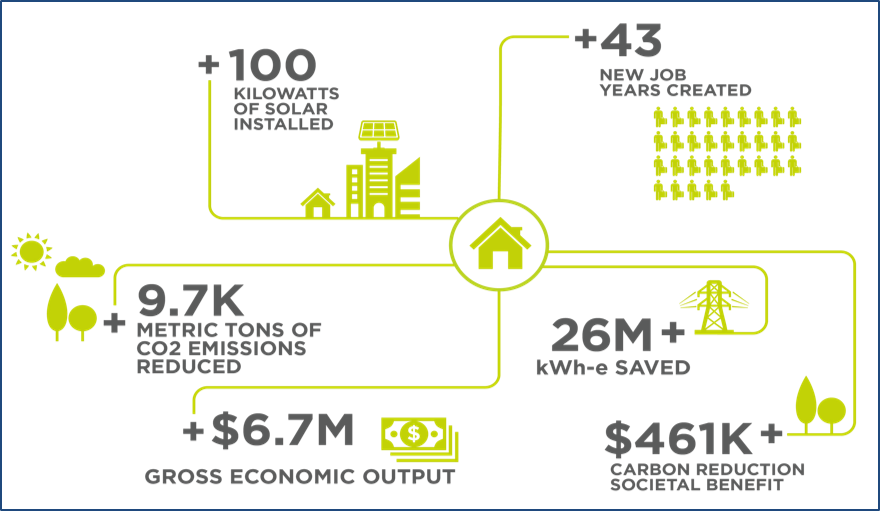
Approximately $3.7 Million was spent on 212 separate Set The PACE St. Louis energy efficiency, renewable energy, and climate resilience property improvement projects for residential and small commercial (under $750,000) buildings located in the City of St. Louis between May 2017 and December 2019. Ygrene Energy Fund is the Program Administrator of the Set The PACE St. Louis Residential/Small Commercial program for the City of St. Louis and its Clean Energy Development Board. The calculations are based on data utilizing Ygrene's triple bottom line Sustainability Impact Metrics for the Residential/Small Commercial PACE program. In addition, 17 of the 80 authorized contractors in St. Louis were minority or women owned businesses.
The St. Louis Climate Handprint
Taking positive action to help the environment in day to day actions and decisions. For suggestions on how to make a difference in addressing the challenge of climate change, check out these Good - Better - Best recommendations for how individuals can take climate action At Home and At Work.
Alternative Transportation
Complete Streets Ordinance
In June 2010, former Mayor Slay signed the Complete Streets bill into law, encouraging transportation planners and engineers to keep walkers, cyclists and public transit users in mind, not just drivers. In 2015, Mayor Slay signed a more robust Complete Streets ordinance. "Complete streets" are those that are specifically designed to safely accommodate multiple modes of transportation. They have been shown to help reduce reliance on cars, stimulate economy, reduce harmful emissions and promote healthier living.
Cycling Initiative
Through its cycling initiative, the City of St. Louis has embraced alternative means of transportation (such as walking or biking) as healthy and environmentally-friendly ways of getting around. The City has a Bike-Ped Coordinator position, and many details about Bicycling in the City can be found in the Streets Department, which houses the Bike-Ped Coordinator postition and oversees the City's Dockless Bike Share program.
The City is a regional leader in cycling facilities, and is adding bike lanes and racks in partnership with Great Rivers Greenway District and the Bike St. Louis master plan. In 2017, the City of St. Louis was deemed Silver Level Bicycle Friendly Community by the League of American Bicyclists. Through the efforts of both city government and non-profit organizations, a number of initiatives now promote alternative transportation in the City.
The City partners with local non-profit organizations such as Great Rivers Greenway and Trailnet to make alternative transportation more viable and prevalent. Together with the City of St. Louis, these groups created a Commuter Bicycle Station in downtown St. Louis. The Downtown Bicycle Station is a 1,430 square feet, offer secure access and feature more than 100 bike racks, showers, and lockers ideal for cyclists commuting to work. Such collaborative projects helped St. Louis win an All American City award in 2008.
Help Us Improve This Page
Did you notice an error? Is there information that you expected to find on this page, but didn't? Let us know below, and we'll work on it.
Feedback is anonymous.


